what happened to angelina on 60 days in
Angelina Jolie sits at a desk, dorsum direct as a rule and rather majestic. Her features are cartoonishly beautiful – straight blackness hair, vertiginous cheekbones, huge blue optics and lips like a plumped cherry sofa. She is talking on Zoom to four young activists. It is a horribly apt day to be discussing human being rights – the Taliban has but captured Ghazni city on its approach to Kabul, the uppercase of Afghanistan.
If this were a picture, yous might suspect Jolie was playing a divine leader addressing the fortunate few. Yet it before long becomes apparent that things aren't quite every bit they seem. The player and pic director is the ane in awe, not the activists. The young people talk about the piece of work they take washed raising awareness of the carnage in Syria, the environmental crisis, trans rights and food poverty. Jolie hangs on their every word. She tells them they have inspired her children who follow their piece of work, warns them confronting burnout, apologises for the failings of her generation and says how honoured she is to meet them.
The side by side evening it is but Jolie and me Zooming. In the background I tin can hear kids playing. Our conversation is frequently interrupted by the ferocious roar of her rottweiler Dusty, who appears to believe he is a panthera leo. Information technology's been an even more depressing day for human being rights – the Taliban has entered Kabul and toppled the Afghanistan regime. Jolie says the only thing giving her hope is the young people we met last night. "They speak about these issues with more urgency and awareness of what is morally right and decent than any politician, any diplomat, whatsoever NGOs I've worked with."
She says she can't stop thinking well-nigh Muhammad Najem, a 19-year-old who literally shouted from the rooftops nearly the Syrian regime's siege of his domicile hamlet, Eastern Ghouta. After his father was killed iv years ago in an airstrike on the mosque where he was praying, Muhammad and his brother would await for the daily bombing to stop, film the carnage from their roof and document the suffering of survivors. He and his family soon became government targets, and fled to Turkey from where he spoke to us. Information technology wasn't just his bravery that was notable; information technology was the warmth of his smile, his zest for life, despite all he has seen. Since we concluding spoke, Jolie has Zoomed over again with Muhammad and a daughter who is candidature against flow poverty. "His relationship to that teenage girl and her activism was more in melody than near any man I've met," Jolie says. We agree that cloning Muhammad may be the answer to globe peace. "He is that evolved man!" Jolie says.
"Grrrrrrrrr!" Dusty roars, plainly in agreement.
Jolie has spent 20 years candidature for human being rights, first equally a goodwill ambassador and then special envoy for the Un loftier commissioner for refugees. She has carried out more than 60 field missions, invariably with notepad and pen in hand, bearing witness to people displaced by war and persecution in countries such as Syria, Sierra Leone, Iraq and Afghanistan.
Now Jolie, 46, has written a volume with child rights lawyer Geraldine Van Bueren QC and Amnesty International, called Know Your Rights, a guide for young people named after the Disharmonism song whose title is also tattooed on Jolie'due south back. The book lays out all the rights children have under the UN convention on the rights of the child, ratified by 196 countries, explains how to claim them and offers advice from young people who have done. Know Your Rights tackles all the big issues in a chatty, accessible way – from the rights to life, dignity, wellness, equality and non-discrimination, criminal justice, a safe place, liberty of thought and expression, privacy, peaceful protestation, play and educational activity, to the right to protections from harm and armed violence.
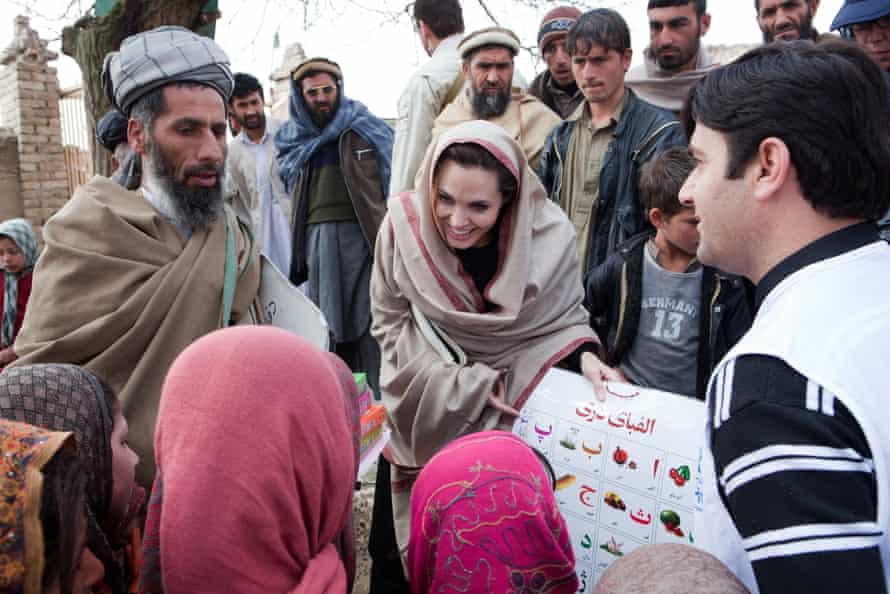
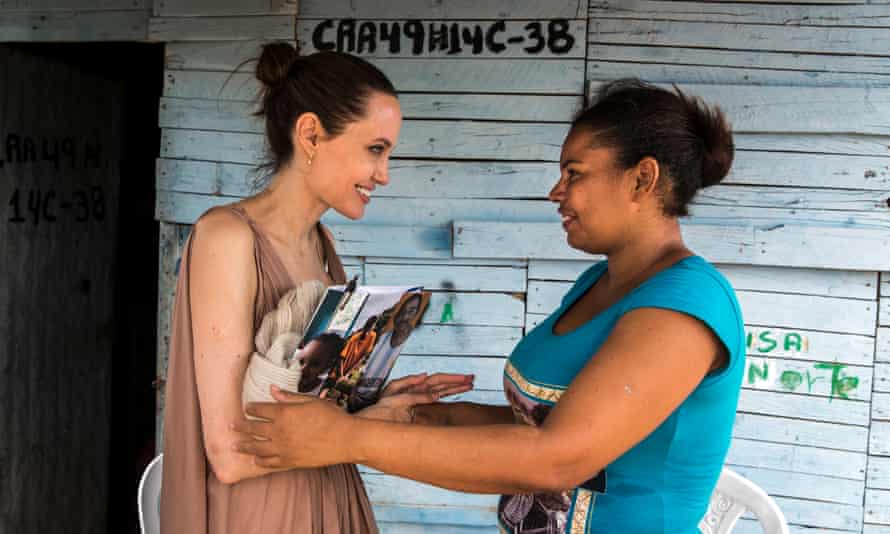
I ask Jolie why she has written the book. "I've met too many children who alive with the effect of their rights existence violated – displaced people, young rape victims. I couldn't sympathise why they were withal fighting for basic things that were their rights to begin with. It made me very angry. How are we going to solve annihilation if we're not addressing that, right?" Her explanation is fluent and authoritative – and not surprising.
But the next bit is. "Then I had an experience in us with my own children and I idea... well, human rights, children's rights." All of a sudden the fluency is gone. Her language becomes disjointed and elliptical. "I remembered the rights of the child, and I took them out and looked at them and idea: well, these are for when y'all're in a situation and you desire to brand sure at that place is back up for the children in your life."
She apologises, and says she can't be more direct. "Then I establish out the US hadn't ratified the rights of the kid. One of the means information technology affects children is their vox in courtroom – a child in Europe would have a better take chances of having a vox in court than a child in California. That said a lot to me most this land."
What happened that fabricated her fearfulness for her children'southward rights. "I... I'm nevertheless in my own legal situation," she stammers. "I can't speak about that." Await, I say, there has been so much nonsense written about you over the years, information technology's impossible to distinguish between truth and fiction – you lot take to help me empathize what you lot are alluding to. Are you talking virtually your divorce from Brad Pitt and the allegations you lot take made against him of domestic abuse? She tells me she is sworn to silence. Well, nod if yous're talking about the divorce and allegations. She nods. And did she fear for the safety of her children? This time she answers. "Yes, for my family. My whole family."
It would be amazing, I say, to spend your life on the world stage, highlighting the abuse of children's rights, then discover that these aforementioned rights may have been compromised then close to home. "Often y'all cannot recognise something in a personal manner, especially if your focus is on the greatest global injustices, because everything else seems smaller. It's so hard. I'd similar to exist able to have this give-and-take and it's and then important..." She makes a couple of efforts to complete her sentence, gives upwardly and starts again. And now the fluency returns. "I'chiliad non the kind of person who makes decisions similar the decisions I had to make lightly. It took a lot for me to be in a position where I felt I had to separate from the father of my children."
A ngelina Jolie and Brad Pitt were Hollywood's aureate couple; so famous that they had a portmanteau moniker, Brangelina. And Brangelina was, aptly, the ultimate celebrity brand. Both are Oscar winners, among the highest paid stars in the motion picture business concern (Pitt is said to exist worth $300m, Jolie $150m), mainstream draws and indie icons, and of course utterly gorgeous (Pitt was twice voted the sexiest man alive by People magazine, while Jolie was named sexiest woman alive by Esquire mag in 2004). Merely Brangelina as well became a byword for celebrity altrusim and consciousness-raising. Pitt accompanied Jolie on many of her UNHCR trips, they opened schools in state of war-torn countries, and iii of their six children were adopted from countries brutalised by disharmonize and poverty – xx-year-old Maddox is Cambodian, 17-year-old Pax is Vietnamese and xvi-year-old Zahara is Ethiopian. They even managed to manipulate the media to their own ends. Faced with the inevitability of being papped when their daughter Shiloh was born in 2006, Jolie and Pitt auctioned off the photoshoot to People magazine in the United states of america and Hello! in Great britain for $7.6m. Two years after, when twins Knox and Vivienne arrived, they sold the shoot to the aforementioned magazines for an estimated $14m, making them the most expensive celebrity photos in history. On both occasions, the proceeds went to the Jolie-Pitt Foundation to fund humanitarian projects. As a couple, they seemed besides expert (or at to the lowest degree likewise successful) to be true.
And so it proved. In September 2016, Jolie filed for divorce from Pitt, which was finalised in 2019. Just they are still locked in a bitter custody battle, after she alleged domestic violence against him. In November 2016, the FBI announced no charges would be brought confronting Pitt, and cleared him of whatsoever wrongdoing, following an incident a couple of months earlier on their private aeroplane in which it was alleged that a drunkard Pitt was calumniating with Maddox, then 15. Five days after the incident, Jolie filed for divorce, citing irreconcilable differences and stating that her decision to finish the marriage "was fabricated for the wellness of the family". Pitt admitted he had an alcohol problem (he attended Alcoholics Anonymous after their separation) and that he had yelled at one of his children, but has always denied being physically abusive to them. Jolie refuses to say annihilation most the incident due to court proceedings. Pitt's lawyers declined to comment when invited to do so by the Guardian.
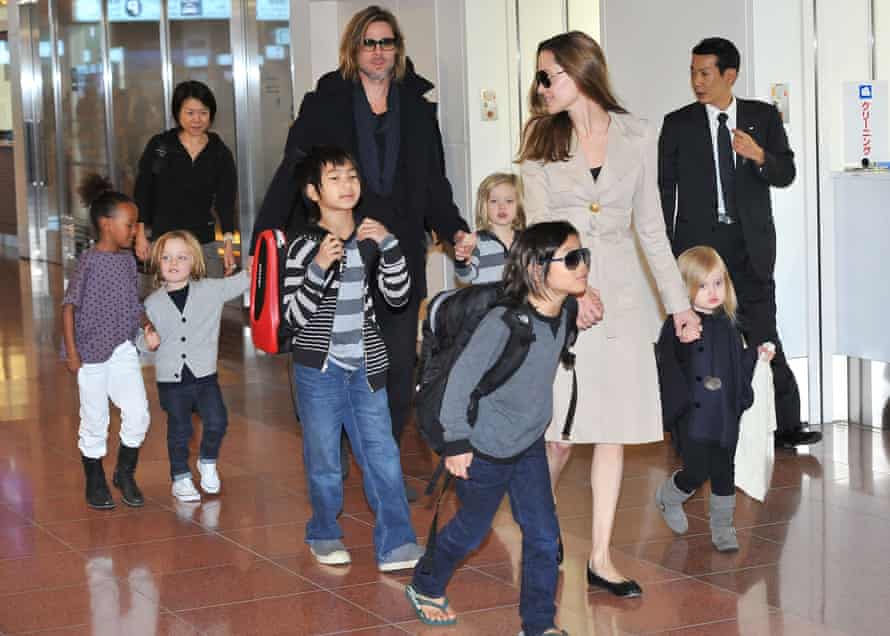
Today Jolie is at home in Los Feliz, a residential neighbourhood near the Hollywood Hills. She bought the mansion, which cost a reputed $25m and used to be home to the film-maker Cecil B DeMille, to make it easier for the children to visit Pitt after the separation. For most of the past five years she has had custody, while he has had visitation rights. Although information technology has frequently been reported that the issues leading to the electric current courtroom proceedings were nigh Jolie fighting for sole custody, in fact they were about how a healthy articulation custody relationship could be accomplished.
I tin hear a couple of the children playing in the groundwork, while Dusty continues to make regular contributions to the conversation. "What I know is when a child has been harmed, physically, emotionally, or witnessed the harm of somebody they love or care for, it can cause damage to that child. I of the reasons children need to accept these rights is because without them they are vulnerable to living dangerous, unhealthy lives." She may be talking about children in general, but information technology sounds personal. In the custody battle, much of the globe appears to have taken sides. Some family unit law attorneys have criticised Jolie for wanting her children to testify against their begetter, while Jolie suggests it would exist a betrayal of their rights for her to allow information technology rest. Meanwhile, Jolie's lawyers have said three of the children accept asked to give their testimony.
I enquire Jolie when she kickoff became aware of human rights and she starts to talk nigh her female parent's values. "She didn't come at them every bit if information technology was a job or a calling, she was just kind. She was a decent homo who was bothered when she saw people mistreated. It was actually that simple."
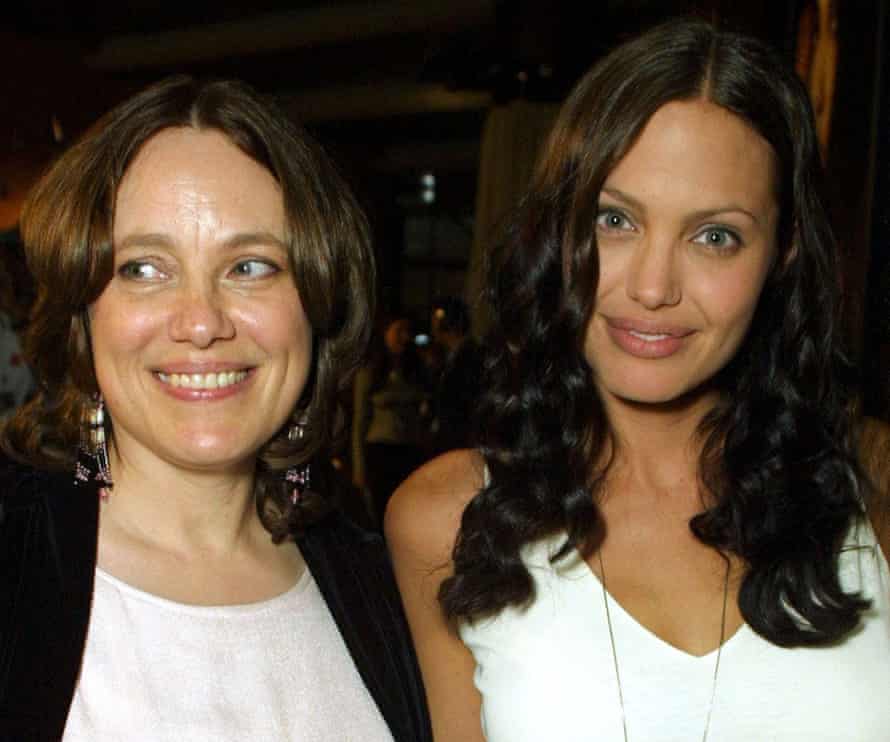
Jolie's mother, Marcheline Bertrand, who died of ovarian cancer in 2007, anile 56, trained as an actor, hung out with Jim Morrison when she was young, and by the cease of her life was the partner of Native American activist and poet John Trudell. Jolie'southward father, the actor Jon Voight, was Oscar-nominated for Midnight Cowboy (1969) and won best player for Coming Dwelling in 1979, but was a less impressive parent in Jolie'southward eyes. She says her female parent sacrificed her career to bring up her two children (Jolie has an older brother, James Haven), largely as a single parent. "My mom married at 21, and by the fourth dimension she was 25 she was divorced with two little kids. She couldn't exist the creative person she wanted to be, only she raised her children with art and creativity. Fifty-fifty if information technology was a birthday party, she found a fashion to put those talents to use."
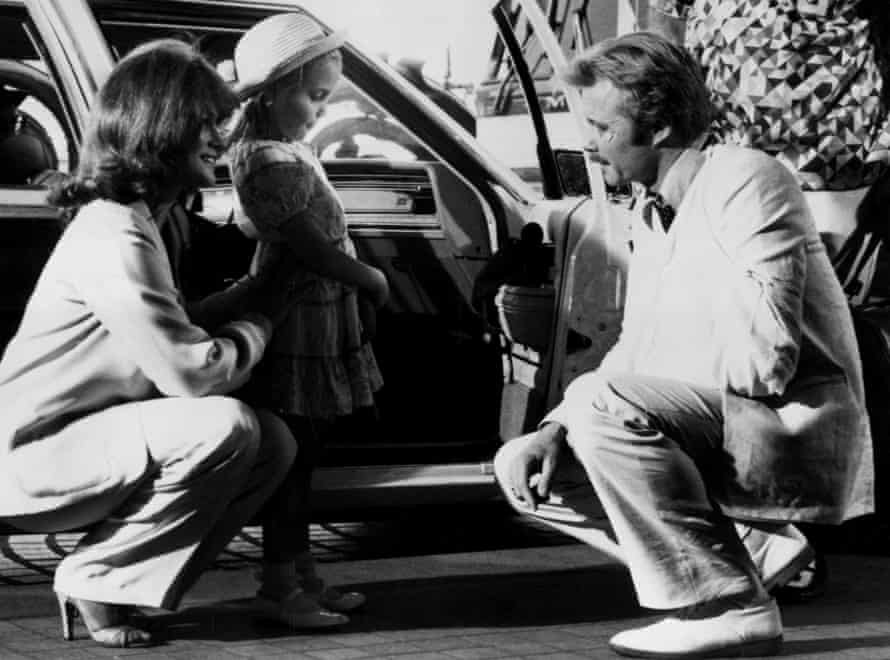
She says what she loved most her mother is that she embraced difference and was open to all experiences. "She didn't try to brand me a mould of her. We were very unlike as women."
In what way? "She would always desire me to sit next to the stranger on the plane considering she was shy, right? While I loved her softness, she loved my strength. She was very still, and I'thou constantly in movement. I was very sexual, and she was much more of a lady. But she saw my true self and encouraged it fully, and she taught me to do that for my own children. My children are all very unlike from each other."
Her mother always told Jolie to exist useful in life, only as a teenager, she says, she didn't know what she meant. She experimented with drugs, including heroin, drank excessively and cut herself in an attempt to overcome an overwhelming sense of emptiness. She had her first live-in lover at 14. Her mother suggested her beau move in to end her leaving home and going further off the rail. Jolie was anti-establishment, and outspoken, but she was also a mess. "It took me a good while to feel I could be of use to anyone considering I felt for a long time that I was a little crazy, that I was a little unhinged, and not settled. If you would take asked me as a teenager if I could have been everyone's mom, or of any use to the United nations or write a book, I would take said absolutely non."
With the do good of retrospect, does she still feel she was unhinged? "Peradventure that'due south what's so helpful virtually meeting with all these young people. They are reminding me that back at the time I felt I was a bit crazy for challenging a organization, or being angry about sure things I was witnessing, I wasn't incorrect. To be around all these immature people who take, for good reason, a sense of fight and rebellion and willingness to go far there and drain if necessary for something they know is incorrect – it reminds me of who I was when I was younger. And it reminds me that it isn't something bad."
Back then, Jolie would also bleed for a cause, even if she wasn't sure what the crusade was. When she married the histrion Jonny Lee Miller at the age of 20, she wore a T-shirt with his name inscribed on it in her blood. When she was with her second husband, Baton Bob Thornton, they wore vials of each other's claret effectually their necks. She appeared on TV shows, doing outrageous tricks with butterfly knives. It was hard to work out if she was a raging self-publicist, dangerous, or both.
Looking at Jolie today, information technology's difficult to connect the urbane adult female in the Saint Laurent suits with the punk in the leather jacket. But Jolie says they are very much the same person; she just didn't know how to focus her energy. "I was rudderless. I was seeking liberty, truth, feeling. I wanted to feel deeply and experience deeply." She laughs. "Listen, I grew upwardly in Hollywood. This boondocks is disturbing. I was hurt from a lot of different things in life."
What hurt so much when she was young? Again, she returns to her mother. "My mom was in a lot of hurting. My father had an affair, and and then there were a lot of challenges with child support and alimony. Then she lost her parents, and was quite broken, so I was determined to help her when I was young." She was told she could be an thespian or a model "as if it's this smashing thing", merely now she's non and then sure. She suggests that had she been a boy, other choices would have been offered. "Nobody tells you lot you can be a managing director or a lawyer. So I was pushed downwards a path, and I wanted to be successful to financially help her, and to be able to make more choices in her life and my life."
She says her female parent was not merely denied a career, but also a voice. "I realised when I was young, the person who had a public vocalism had more power than the very kind, decent woman at home doing all the right things and making all the sacrifices." She is referring to her father, an outspoken Trump supporter who said that the campaign to go the United states ballot result overturned was "the greatest fight since the civil state of war – the boxing of righteousness versus Satan", and from whom she has often been estranged. Jolie says she was determined that she would non be silenced every bit her mother had been. "I don't retrieve I came into this business because I wanted to be an actor. I came into it because that'southward where y'all could accept a vocalization. When you lot have somebody who controls the finances and controls the family narrative because they are public, y'all're all under that person."
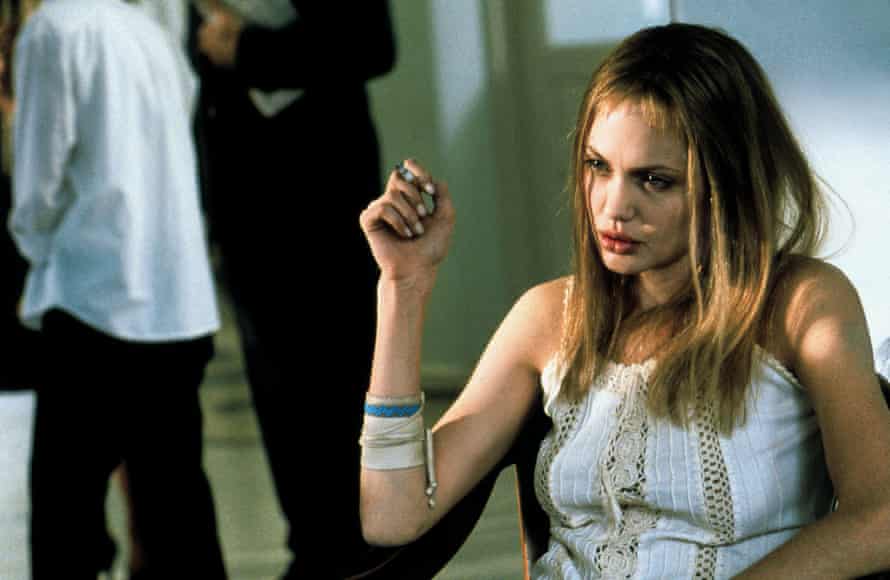
At the historic period of seven, Jolie fabricated her moving picture debut in Hal Ashby's Lookin' To Get Out, playing the girl of Voight's graphic symbol. By xvi, she was modelling swimwear, and at 20 she was starring in Hackers aslope time to come husband Jonny Lee Miller. In 2000, at the age of 24, she won the all-time supporting actress Oscar for her visceral portrait of a psychiatric patient in Girl, Interrupted. In 2013, she earned an estimated $33m, mainly from her contract with Louis Vuitton and her appearance as the eponymous witch in Maleficent. Her choice of acting roles suggests she acts primarily for the money – alongside the odd quality picture (she was great as Mariane Pearl, the wife of Wall Street Journal reporter Daniel Pearl in A Mighty Heart, despite the controversy of a white woman playing a mixed-race character), there take been any number of stinkers.
Before separating from Pitt, she was establishing herself as a film-maker. First They Killed My Father, the final picture show she fabricated equally a director (released in 2017), is a haunting portrait of life under the Khmer Rouge, in which she coaxed exceptional, understated performances from her actors – especially the children. Since then, her career has taken a back seat as she has dedicated herself to being pretty much a full-time mother.
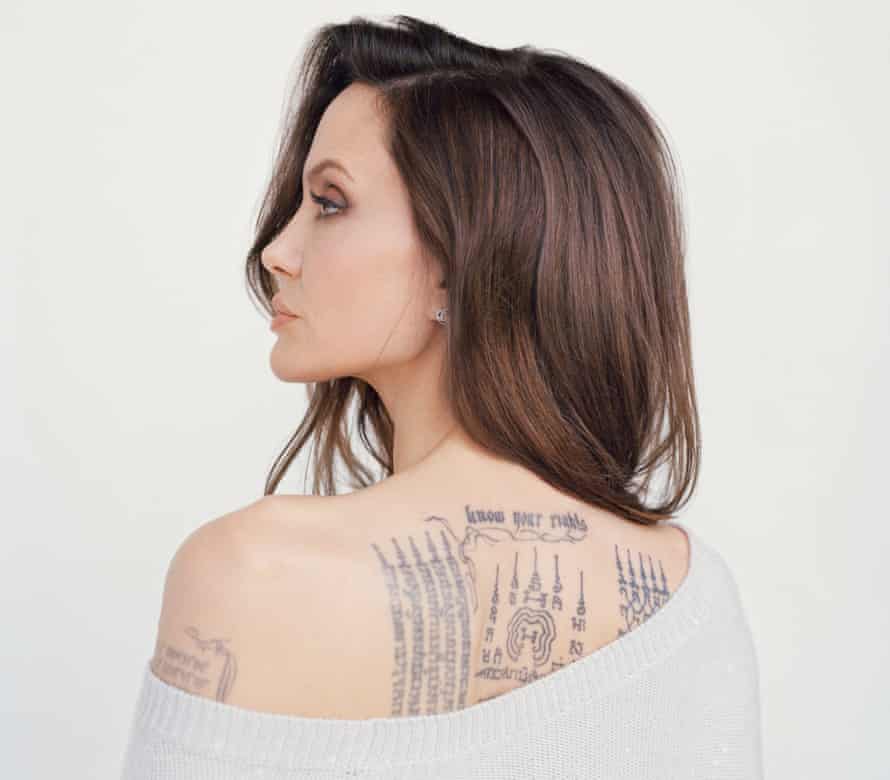
Does she feel her rights have always been respected? "Hmm. A proficient therapy question." She pauses. "I think my mother did a lot to ensure my rights and empower me. Only you lot know, I started working actually immature to help her pay bills and stuff. And I wasn't aware of how I deserved to exist treated as a young girl and a human being. I didn't feel I was born with these rights and protections. I felt that these were things you had to need or fight for, and sometimes be seen every bit difficult when you do." Is she seen every bit hard? "I will certainly claiming whoever'south in my way to go to whatever it is I think needs to be done."
When was the starting time time she felt sufficiently disrespected in the industry to tell somebody to fuck off? "Erm… well, no surprise, Harvey Weinstein. I worked with him when I was young." She was 21 when she made the Miramax film Playing By Middle, executive produced past the infamous sexual predator and convicted rapist. She says women oft play down an assault if they manage to escape – as she did at the fourth dimension. "If you lot go yourself out of the room, you call up he attempted but didn't, right? The truth is that the try and the experience of the attempt is an assault."
What happened? "I really don't desire to derail the book into stories almost Harvey." But that was an corruption of rights? "It was. Information technology was beyond a pass, it was something I had to escape. I stayed away and warned people almost him. I think telling Jonny, my first married man, who was not bad most information technology, to spread the word to other guys – don't allow girls go alone with him. I was asked to do The Aviator, but I said no because he was involved. I never associated or worked with him over again. It was hard for me when Brad did."
In 2009, Pitt starred in Quentin Tarantino's Inglourious Basterds, co-produced by the Weinstein Visitor. In 2012, she says Pitt approached Weinstein to work equally a producer for the noir thriller Killing Them Softly, which the Weinstein Company afterwards distributed. In doing so, Jolie felt he was minimising the sexual attack she had endured. "We fought nearly information technology. Of course it injure," Jolie says about Pitt beingness happy to piece of work with Weinstein, despite knowing he had assaulted her. She avoided attending promotional events for the pic. Weinstein, who is currently serving a 23-year jail judgement for rape and sexual assault, denies Jolie's accusation.
Jolie is drinking from a bottle as she talks. What is it? "It's kombucha. It'southward not alcohol – non yet anyway!" She giggles and takes another swig. I enquire if her children are interested in activism. She tells me that they're all very unlike, merely it's hard for them not to exist because of the manner the family came about.
"Grrrrrrrrrrrrr," Dusty roars.
"Within the understanding that they are family comes a lot of sensation that has to be built-in of all the years of them growing up together, learning from each other, discussing adoption, race and family unit. Having people say: how could y'all be sisters, you lot're not the aforementioned colour, when you're a piddling child. Going to each other'south countries and being the only person of their background in that country and feeling exterior, even so it's your family."
I ask Jolie if she ever wanted to adopt. No, she says: when she was growing up she didn't desire children. "I never wanted to babysit, I never had dolls, and so it'due south hilarious I've ended up with half dozen children." What did you have instead of dolls? "I liked to play office. So in my late teens I became aware of what adoption is, and the idea that there were children effectually the world who had been orphaned, and it only fabricated sense to me. I never have had this thought of 'my own blood'." Fifty-fifty though she gave nascency to three children fathered by Pitt, genetics has never interested her. "It was just family unit born of being together and growing together, right?" She ofttimes concludes a sentence with correct – role question, part declaration.
In 2013, Jolie wrote an op-ed in the New York Times revealing that she had had a preventive double mastectomy because she was a carrier of the BRCA1 genetic mutation that had killed her mother and put her at high risk of breast and ovarian cancer. Ii years after, she wrote some other article announcing she had also had surgery to remove her ovaries and fallopian tubes. It was unheard of to hear a Hollywood A-lister at the peak of her career discussing these problems. Just it proved a gamechanger. A yr later a UK report found that her decision to become public on the mastectomy led to a doubling in NHS referrals for genetic tests of chest cancer risk.
Was going public a form of activism, I ask. Well, she says, she certainly wouldn't use that word to describe it. In fact, she adds, she rarely uses the word full stop. Was it a way of saying to people: if preventive surgery tin can make sense for me, it can for yous, too? "As I've gone through my life, I've never had that confidence that if I do this it will make a deviation. I don't think of myself in that way. It's just me thinking: if my mom knew about this and had this surgery and she had read an op-ed similar this, she might still be live. Therefore I really feel I should write this, because maybe somebody's mom will read it."

I tell her I find it fascinating, the binary way in which she is portrayed – either as a saint or a crazy, an curvation manipulator. (It has been suggested that she is fighting for custody of the children simply because she wants to move out of America – something she denies.) "I think people sometimes only demand people to be what they need them to be. What matters to me is that if people remember this or that about me, does it touch my ability to work for children's rights? Does information technology affect my ability to work with Muhammad and help him? If you truly recall I'm crazy, and then that's a trouble, because you may non heed to him equally much and may non value me saying how important he is or this book is."
Equally she talks, I notice how tired she looks. While refusing to discuss details about her divorce, she has said that the experience has been traumatic and has left her feeling "broken". What have the past five years taken out of her? In that location is a long pause. She cups her face in her hands, and looks gear up to burst into tears. "I mean, in some ways it's been the last decade. There's a lot I can't say," she repeats. "I call up at the end of the solar day, even if y'all and a few people you love are the only people who know the truth of your life, what you fight for, or what you sacrifice, or what you've suffered, yous come up to be at peace with that, regardless of everything going on around y'all."
Has it proved difficult to come out of all this at peace with herself? "I'1000 not out of it," she says, quietly. I suppose what I'm request in a clumsy fashion is: how are you? She looks even more upset. "Information technology's really difficult to answer." Some other pause. "How am I? I'chiliad realising that sometimes you can survive things, but not know how to feel and alive in the aforementioned way. So it's more nearly being open. I'chiliad really trying to be open equally a human beingness over again."
D iscovering that the convention on the rights of the child has not been ratified past the U.s.a. has given her a sense of purpose: rather than simply fighting for her children, she tin come across it as a bigger human being rights cause. She is trying to put a positive spin on her situation. "It has been so horrific that I most take to see it as a godsend to be in a position to be able to fight this organisation. It doesn't start with the violation [the plane incident]. It's so much more complicated than that." She says the lack of ratification has had a significant touch on on her battle: "My 17-year-old, for instance, has been denied a voice in court."
Jolie is complex, and at times contradictory. She tells me she wants to talk about all this; the adjacent minute, she changes her mind. "It's not that I want to talk about anything really, because I just desire my family to heal. And I want anybody to move forward – all of us, including their dad. I want u.s. to heal and be peaceful. We'll always be a family." Information technology's not only Jolie who's complex; and so is the situation. Information technology's difficult to encounter how even she could press ahead with her accusation of domestic violence and achieve a peaceful resolution.
When I mention how upset she looks, she admits she has been emotional today, since seeing the Taliban take over Kabul. "This morning I but had a large cry virtually Transitional islamic state of afghanistan. That was the get-go for me, 20 years ago – those first few trips when you come across people and actually connect. You see little kids, see the promises fabricated, the efforts made, the trust given, see everything, then you track them existence put on trucks to be sent back, and yous track them dorsum in Kabul, and at school, and y'all get a sense of the pain and fearfulness and expiry and the horror and the betrayal and the trauma. Information technology'south disgusting. It says too much about the world nosotros're living in today. It says too much nigh where nosotros're at."
Only at the aforementioned time, it makes her think virtually Muhammad and the 3 other activists we met, fighting then fiercely for a better world. It makes her think of all the terrible merchandise-offs that politicians make that lead to outcomes such as Afghanistan. It makes her think of her young self, refusing to yield to convention, and all those people who have dismissed her as bats in the intervening years for believing that justice and humanity tin win the twenty-four hour period rather than realpolitik. "No," she says, her self-belief restored, "I'1000 non crazy."
Know Your Rights by Angelina Jolie is published by Andersen Press at £vii.99. To support the Guardian and Observer, society your re-create at guardianbookshop.com. Delivery charges may utilize.
Source: https://www.theguardian.com/film/2021/sep/04/angelina-jolie-i-just-want-my-family-to-heal
0 Response to "what happened to angelina on 60 days in"
Post a Comment